
Updated July 2026
How Much Concrete Do I Need?
One of the most common questions we hear from homeowners and contractors is:
“How much concrete do I actually need?”
Because we handle ready-mix concrete delivery throughout Lake Norman and the greater Charlotte area, this is a question our team helps customers solve every day.
Ordering too little can get expensive fast, unnecessary call-backs, wasted time, or worse, shutting a job down entirely. Ordering too much wastes money. And trying to guess usually ends with stress on pour day.
The good news is that concrete quantities are straightforward once you know how to calculate them. Below, we'll walk through the formula and real examples for driveways, slabs, and footings. And if you'd rather skip the math, there's a calculator further down that does it for you.
The Basic Formula
Concrete is ordered by the cubic yard.
To calculate how much you need:
Measure the length (feet)
Measure the width (feet)
Measure the thickness or depth (inches)
Then use this formula:
(Length × Width × Thickness in inches) ÷ 300 = Cubic yards needed
Why 300?
The true conversion from cubic feet to cubic yards is 324. We use 300 intentionally to build in a small buffer. Concrete jobs rarely go exactly as planned, and being slightly heavy is far better than coming up short.
How Much Concrete Do I Need for a Driveway?

Let’s put this formula to use with a simple example.
Assume you’re pouring a concrete driveway.
A typical residential driveway might be:
20 feet wide
40 feet long
4 inches thick
Calculation:
(20 × 40 × 4) ÷ 300 = 10.67 cubic yards
In real life, you’d order 10.75–11 yards.
If you're budgeting for a concrete driveway in the Mooresville area, we put together a detailed cost breakdown: How Much Does a Concrete Driveway Cost in Mooresville, NC?
Pro tip
Be very sure of your depth measurement. If that driveway averages 4.5 inches instead of 4, the total jumps to 12 yards. At 5 inches, it climbs to 13+ yards.
In our experience, guessing at depth or having an uneven base with deeper spots is the most common reason jobs run short.
Always round up, not down. Most batch plants have a minimum of 1 yard. If you end up 0.25 yard short, you’ll still need to order a full yard to finish the job.
How Much Concrete Do I Need for a Slab?
For slabs like sheds, workshops, or additions, thickness matters.
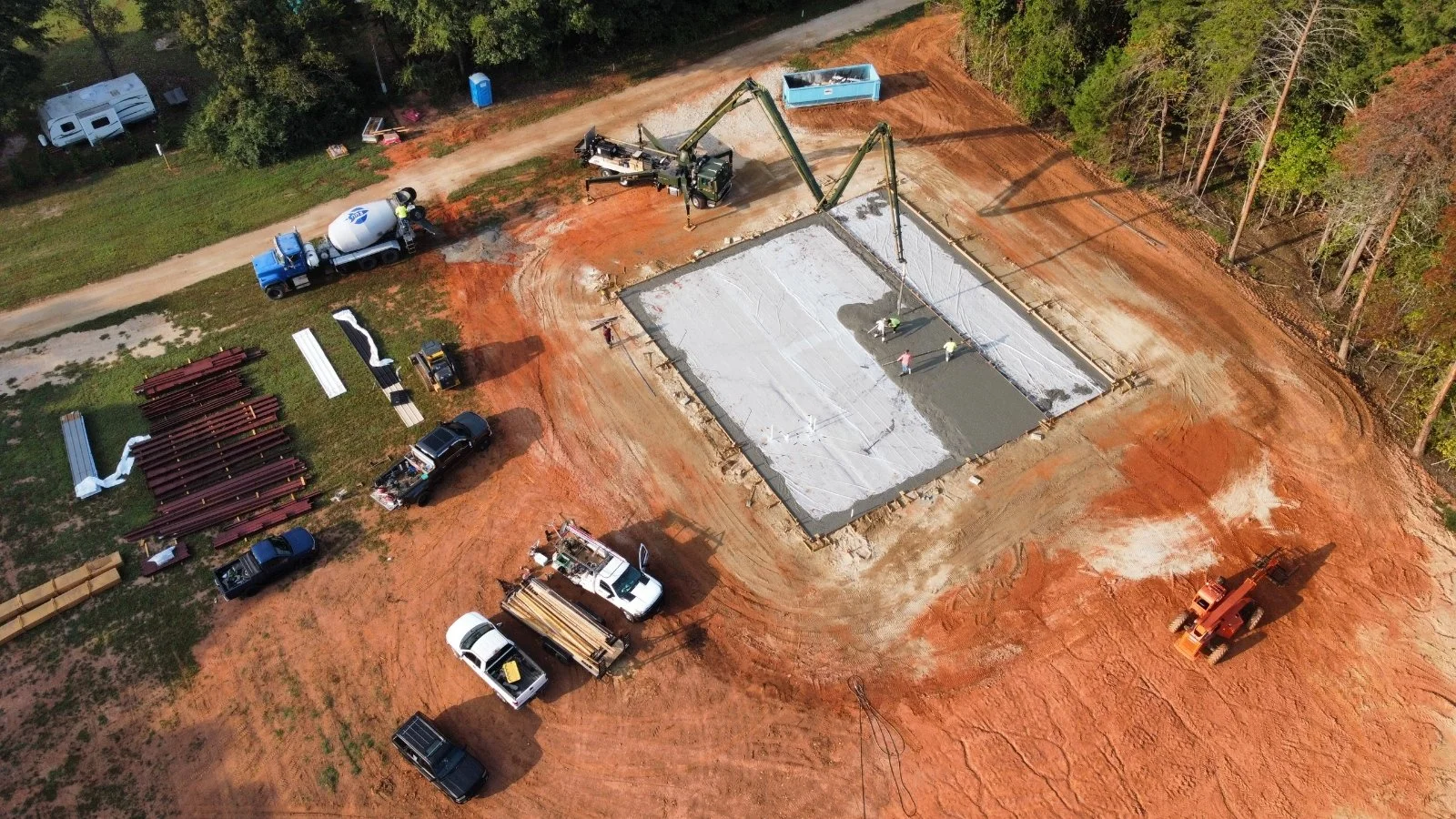
Example slab:
40 feet × 40 feet
4 inches thick
Calculation:
(40 × 40 × 4) ÷ 300 = 21.33 yards
You’d order 21.5 yards.
If the slab is thicker (6 inches), rerun the math — thickness adds up fast.
Pro tip
Our trucks typically carry 10 yards at a time. When a job is close to a number divisible by 10 (like 21 yards), you can order “20+”.
That means we’ll deliver 20 yards first. Once that concrete is down, you can take a measurement and call in the balance needed to finish. This often saves you from over or under-ordering on the final truck.
How Much Concrete Do I Need for Footings?
Footings are usually long, narrow, and deeper than slabs.
Example footing:
40 feet long
2 feet wide
12 inches deep
Calculation:
(40 × 2 × 12) ÷ 300 = 3.2 cubic yards
You’d order 3.25 yards.
Concrete Calculator
Bagged Concrete vs Ready-Mix
A common mistake is underestimating how much labor and expense bagged concrete really involves.
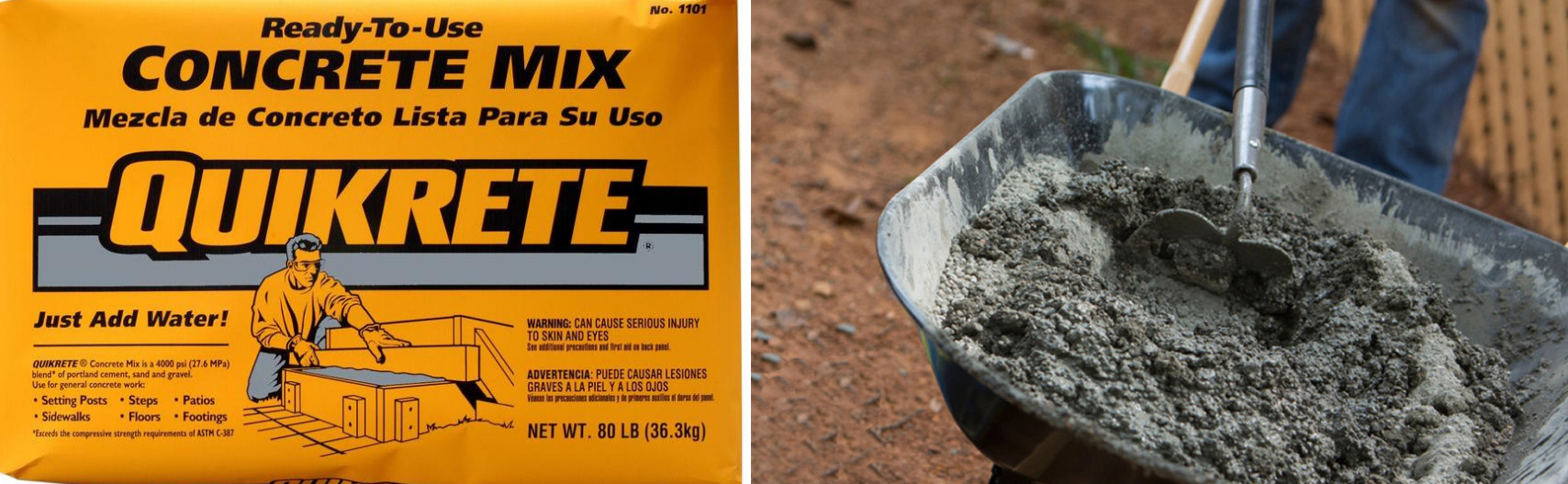
As a rough comparison:
1 cubic yard = 45–50 80-lb bags
So a 2-yard project means:
About 100 bags
As of January 2026, Lowe’s lists 80-lb bags at $5.98 each:
100 × $5.98 = $598 (before tax)
That doesn’t include:
Delivery or store trips
Loading and unloading
Mixing by hand in a wheelbarrow (hours of hard labor)
Or renting a mixer
By comparison, if we deliver 2 yards, the typical cost is about $726 before tax. That $128 difference is more than worth the time, effort, and physical toll of handling 100 bags. And that doesn’t even factor in mix quality or consistency.
That’s why many homeowners and contractors switch to ready-mix delivery once a project goes over 1 yard.
Need a concrete contractor in the greater Charlotte and Lake Norman area? We refer homeowners to vetted local contractors at no charge. No obligation, no hassle. Tell us about your project and we'll connect you with someone we trust. Click the button below for more information.
Common Mistakes to Avoid
Guessing instead of measuring. Don’t eyeball it, use a tape measure!
Forgetting thicker edges or turned-down slabs
Not accounting for grade variations
Ordering exactly the calculated amount with no buffer
Concrete is unforgiving. Being short by even half a yard can create real problems.
FAQs
Do I need to add extra concrete to my order?
Yes. We always recommend ordering a small buffer. Concrete jobs rarely go perfectly, and being short is far more expensive than having a little extra. Uneven subgrades, thicker edges, or slight measurement errors can add up quickly. That’s why we use a conservative calculation and encourage rounding up.
What happens if I come up short on a pour?
If you run short, you’ll need to order additional concrete, and most batch plants have a minimum of one yard. That means even being a quarter-yard short can turn into an extra truck and added cost. Planning ahead and ordering enough the first time helps avoid delays and unnecessary expense.
Can I order concrete if I’m not a contractor?
Yes. Homeowners regularly order concrete for driveways, slabs, footings, and small projects. If you’re unsure about measurements or what makes sense for your job, we’re happy to help walk through it with you before scheduling delivery.
Need Help Figuring It Out?
There are plenty of solid concrete calculators available online, including this concrete volume calculator. Just keep in mind that most online calculators assume perfect conditions and don’t include a buffer, which leaves little margin for error on real-world pours.
If you’re unsure about measurements, thickness, or whether ready-mix makes sense for your project, we’re happy to help.
A quick phone call can save you:
Time
Money
A stressful pour day
Ready to order a delivery?
We deliver ready-mix concrete throughout Mooresville, Statesville, Troutman, Denver, Huntersville, Concord, Davidson, and the greater Charlotte area. Monday–Friday, 7am–5pm.
Call us at 980-281-3131 — we're happy to help you plan your pour.
Want to speak to a concrete contractor?
We maintain a network of vetted concrete contractors across the greater Charlotte and Lake Norman region. Submit your project here and we'll connect you with someone we trust.