
Choosing the Right Additive: Hydration Stabilizer vs. Traditional Retarder
Updated March 2026
When you're pouring concrete in hot weather or on a job with a long haul time, the last thing you want is concrete that starts setting before you're ready for it. Two common additives address this problem, traditional retarders and hydration stabilizers. Here's how they differ and when each makes sense.
What is Retarder?
A retarder slows the chemical reaction between cement and water, buying more time before the concrete begins to set. It's been used in the industry for decades and works well in many situations. The tradeoff is that retarders can produce uneven results, particularly in hot weather, and in some cases affect long-term strength development if not used carefully.
What is Hydration Stabilizer?
A hydration stabilizer takes a more controlled approach. Rather than simply slowing the reaction down, it essentially pauses hydration and resumes it more uniformly once the additive dissipates. This results in more consistent workability, more predictable set times, and better long-term strength compared to traditional retarders.
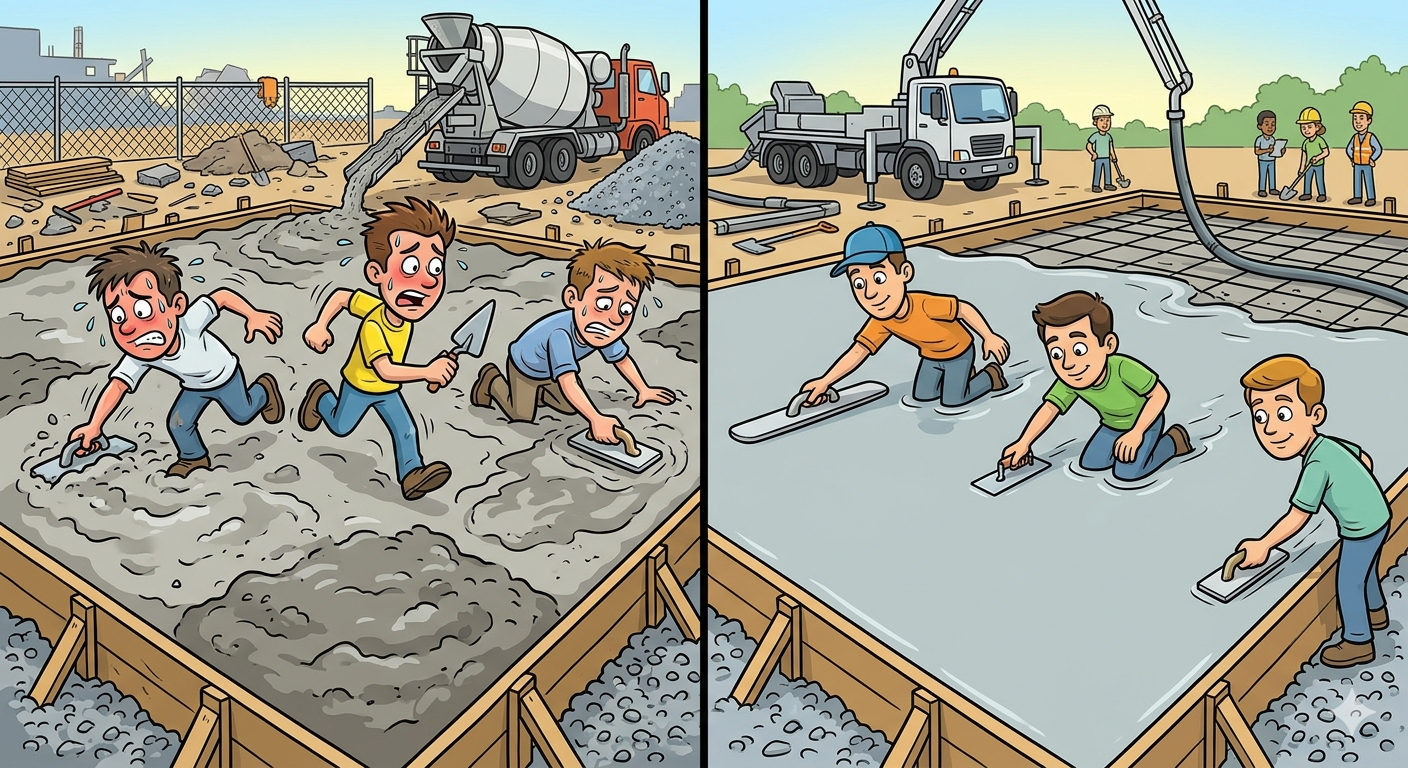
Key Benefits of a Hydration Stabilizer
Enhanced Workability Window
Retarder: Provides extended setting time but can lead to uneven hardening. The concrete can seem to stay plastic and then rapidly set, catching finishers off guard.
Hydration Stabilizer: Offers a more controlled and consistent extension of workability. Finishers say the concrete acts like normal, they just have more time before it starts to set.
Improved Strength and Durability
Retarder: Can sometimes interfere with the long-term strength of the concrete.
Hydration Stabilizer: Maintains the balance of hydration, promoting better curing and resulting in higher long-term strength and durability.
Minimized Risk of Shrinkage Cracking
Retarder: May lead to variable shrinkage rates, increasing the risk of cracks.
Hydration Stabilizer: Ensures a uniform curing process, reducing the likelihood of plastic shrinkage and subsequent cracking.
Which One Should You Use?
For most standard pours with normal haul times, a retarder does the job. But if you're dealing with hot weather, a long haul, or a large pour where timing is critical, a hydration stabilizer is worth the conversation. The cost difference is minimal relative to the risk of a pour going wrong.
When you call to place your order, let us know the conditions you're working with, haul distance, pour size, and weather. We'll help you decide if an additive makes sense and which one fits the job.
Ready to Order a Concrete Delivery?
Rocket Concrete delivers ready-mix concrete throughout the Lake Norman and greater Charlotte region, Mooresville, Statesville, Troutman, Denver, Huntersville, Cornelius, Concord, and surrounding areas. We handle loads from 1 yard to 100+. Give us a call and we'll get you scheduled.
Need a Concrete Contractor?
If you're still looking for someone to handle the pour, we can help with that too. Through our Contractor Connection program, we refer homeowners to vetted local concrete contractors in the Lake Norman and greater Charlotte area.